
Cybersecurity leaders and decision makers face a unique challenge: protecting sensitive data in a world where tomorrow’s quantum computers will render today’s encryption obsolete.
The threat is not theoretical. Nation-states and attackers are already stockpiling encrypted data under “harvest now, decrypt later” strategies. Sensitive records – from financial transactions to government intelligence – risk exposure as soon as cryptographically-relevant quantum computers become practical.
As cybersecurity experts and national authorities are urging organizations to timely migrate their IT infrastructure to quantum-safe technologies, Quantum Key Distribution (QKD) offers an immediate and future-proof solution. By using the laws of quantum physics, QKD provides a method for distributing encryption keys that is immune to both classical and quantum attacks.
QKD is not a replacement for traditional security but a complementary layer in a defense-in-depth strategy, alongside Post-Quantum Cryptography (PQC). Together, these approaches enable organizations to minimize risk early while preserving flexibility and cost-efficiency throughout the migration process.
Contents
What is Quantum Key Distribution (QKD)
How QKD works
Why QKD matters in the quantum era
The case for quantum security
ID Quantique’s quantum-safe product portfolio
QKD applications and quantum-safe network deployments
How to integrate QKD into your network
Security, standards, and implementation maturity
The future of QKD
FAQs about QKD
Get started with quantum security
Quantum Key Distribution is a technology that relies on quantum physics to secure the distribution of symmetric encryption keys. It works by sending photons, which are “quantum particles” of light, across optical links. Today, these links are based on optical fibers, with a corresponding distance limitation caused by loss. Work is also underway to leverage trusted quantum satellites to enable end-to-end global coverage.
Key characteristics of QKD include:
QKD is the foundation for long-term confidentiality, especially for sensitive data with regulatory or geopolitical implications.
The basic principle of QKD is quite straightforward: any eavesdropping attempt changes the state of the system and is immediately detectable.
It exploits the fact that, according to quantum physics, observing a quantum object perturbs it in an irreparable way. If one encodes the value of a digital bit on a single quantum object, its interception will necessarily translate into a perturbation because the eavesdropper is forced to observe it. This perturbation causes errors in the sequence of bits exchanged by the sender and recipient. By checking for the presence of such errors, the two parties can verify whether an eavesdropper was able to gain information on their key.
Once verified, QKD allows two parties to share secret keys with provable security. In practice, QKD is combined with conventional encryption to refresh encryption keys frequently. This approach delivers long-term, quantum-safe protection, even against future quantum computers.
Quantum computers threaten the very foundations of classical cryptography. Shor’s algorithm can factor large integers and solve discrete logarithms efficiently, instantly breaking RSA, Diffie–Hellman and ECC keys of all current sizes. Industry experts now expect quantum-breakable machines by 2029 – or even sooner. This creates a so-called “harvest now, decrypt later” danger: adversaries may record today’s encrypted traffic and decrypt it once a quantum computer is available, which means data with a long shelf life (10-30 years) is already at risk.
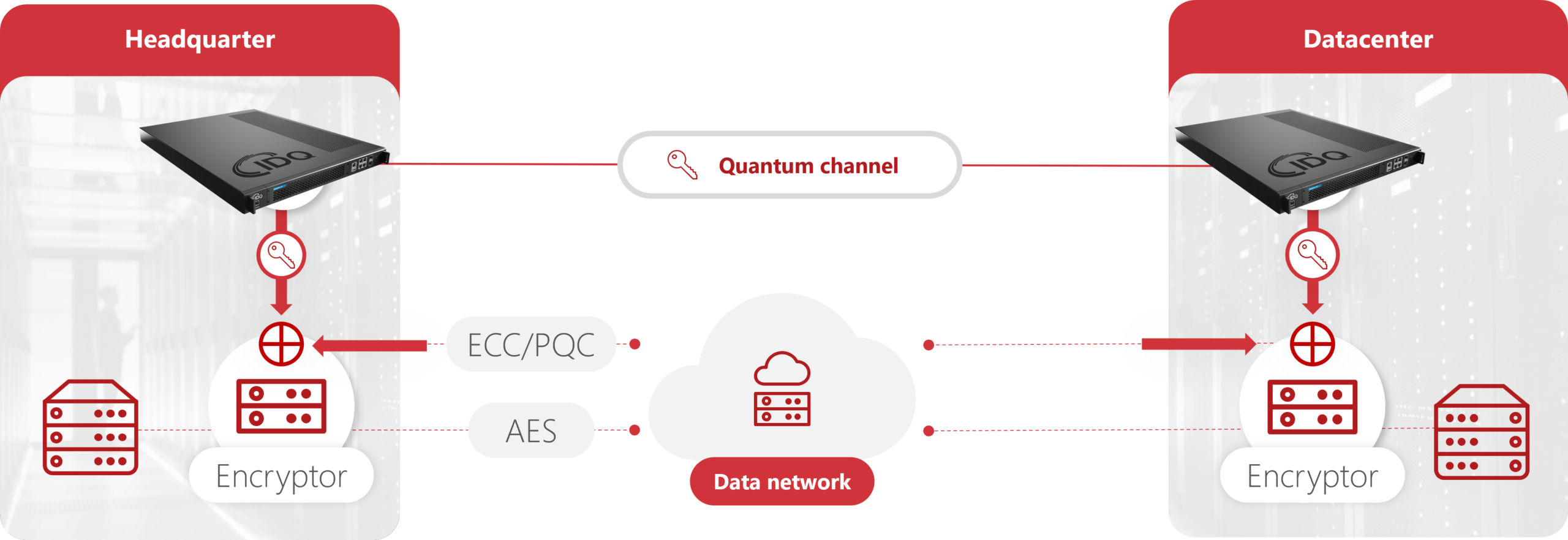
No single quantum-safe method is a silver bullet. Best practice is a layered approach: use QKD alongside post-quantum cryptographic (PQC) algorithms and quantum-safe key management. A hybrid strategy mitigates the unknowns of each: even if a future algorithmic breakthrough undermines some PQC schemes, QKD’s physics-based security remains intact. Conversely, PQC can protect the initial authentication step of QKD and handle digital signatures, roles QKD alone cannot cover.
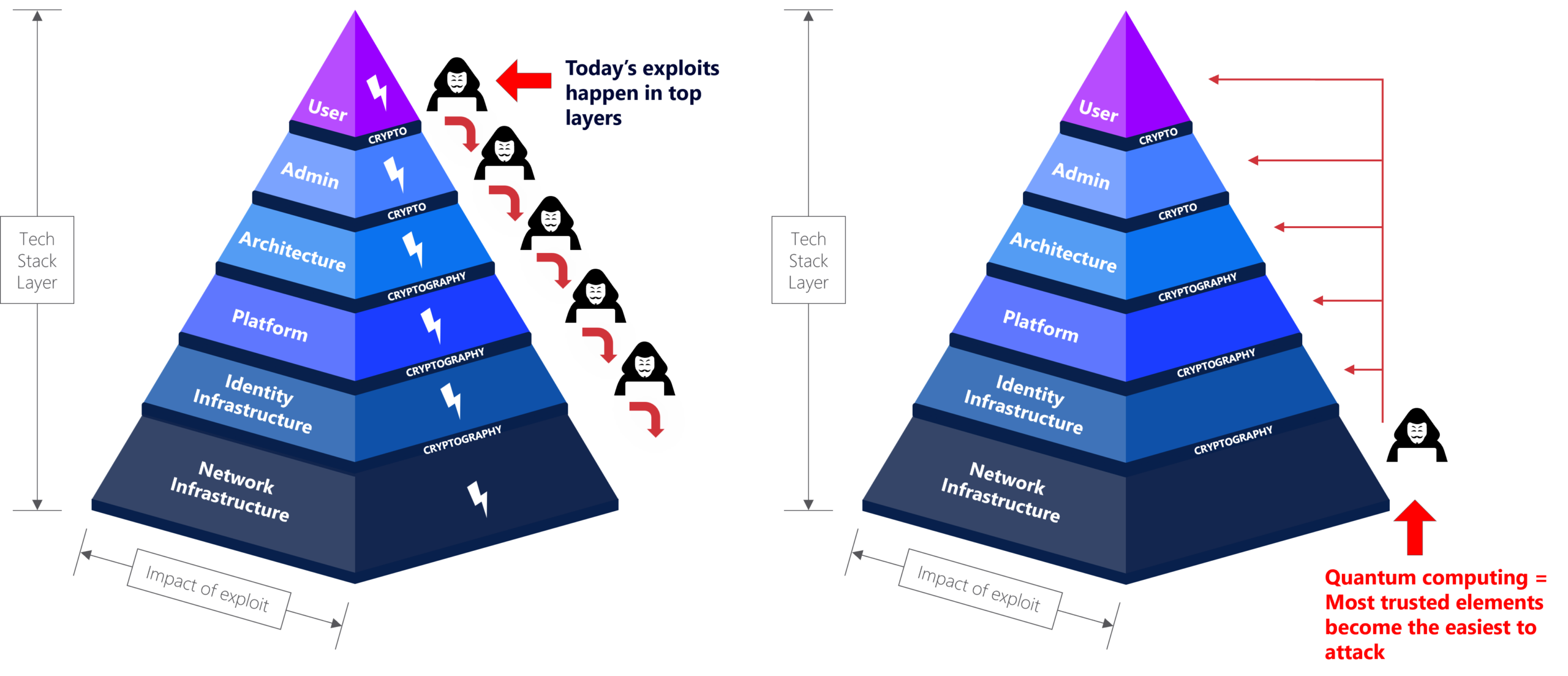
Cybersecurity depends on confidentiality and authentication. Quantum computers threaten both. Quantum-safe security requires two complementary approaches: Post-quantum cryptography (PQC) and QKD. Together, they provide immediate risk reduction, a predictable and efficient migration path, and a durable foundation for long-term resilience.
Best practice is a layered defense combining PQC and QKD, supported by QRNGs for strong entropy and managed through a Quantum Key Management System (Q-KMS) like Clarion KX.

With a 20-year track record, a global customer base, certified integrations with leading network and encryption vendors, and proven reliability in highly available financial, government and enterprise environments, ID Quantique delivers fourth-generation QKD solutions built on open standards, modular architectures and the industry’s largest partner ecosystem.
The Clavis XG portfolio provides quantum-safe, long-distance communications for critical infrastructure and government agencies, with models ranging from short-haul to long-haul dark fiber deployments. These systems protect telecommunications, enterprise, financial, and government networks against today’s cyber threats and future quantum attacks, and can be deployed in simple point-to-point links or complex multi-site architectures using IDQ’s optimized design.
Clavis XG is also available as a research platform designed for academia, research institutes and innovation labs: the Clavis XGR.
All IDQ QKD products are:
IDQ’s quantum security product portfolio is completed with:
IDQ’s quantum-safe solutions are trusted by governments, telecom operators, financial institutions, critical infrastructure providers, and leading enterprises across the globe.
Selected case studies:

Nationwide Quantum-Safe Network – South Korea
Client: Korean Government
ID Quantique and SK Broadband deployed the world’s first nationwide quantum-safe network, connecting 48 government agencies over an 800 km converged infrastructure. Built for national-scale operations, the network supports future expansion through centralized quantum key management.

Nationwide Quantum-Safe Network Plus (NQSN+) – Singapore
Client: Singtel
ID Quantique and Singtel are deploying Singapore’s first enterprise-grade nationwide quantum-safe network. The initiative strengthens national cybersecurity while enabling new Quantum-Safe-as-a-Service offerings for enterprises.

Intercity QKD Infrastructure – Poland
Client: Poznań Supercomputing and Networking Center
A 1,770 km quantum communication network connecting five HPC centers as part of Poland’s national quantum infrastructure. Designed to support advanced research today while enabling secure, real-world applications at scale.

National Quantum Communication Network – Slovakia
Client: Slovak Academy of Sciences
ID Quantique delivered a national-scale quantum communication network combining QKD with post-quantum cryptography. The deployment demonstrates a hybrid quantum-safe architecture designed to protect government communications with long-term confidentiality.

European Quantum Communication Infrastructure (EuroQCI)
Client: EU Member States
EuroQCI aims to establish a secure, operational quantum communication infrastructure across the EU by 2027. ID Quantique has been selected by multiple member states to deploy QKD systems and build national quantum networks.
QKD appliances are pluggable units that connect to dark fiber. They come with management software (Clarion KX) that integrates into your Network Management System. From a user perspective, QKD provides a “key service” – authorized apps ask the key manager for fresh encryption keys, which are delivered with quantum-safe assurance. No fundamental changes to network architecture are needed.
Modern deployments are practical and scalable:

One unified platform to manage hybrid cryptography on network wide key exchange: Clarion KX platform intelligently leverages both agile algorithm-based cryptography and quantum physics-based security to ensure unified, highly secure, out of band key exchange anywhere on the network. It also leverages a NIST-approved source Quantum Random Number Generation (QRNG) everywhere, to provide unbreakable keys.

Clarion KX platform offers unprecedented control over the Key Exchange plane, ensuring full control of your crypto policy management as well as a resilient approach that fully encompasses crypto agility at its core. Its extensive Central Management service suite integrates Software Defined Network (SDN) capabilities, integration into Enterprise services via QNET API as well as IDQ’s Quantum Management System (QMS) Web UI to facilitate all small to large QKD deployments.
QKD is battle-tested and standards-driven:
In summary, QKD technology is production-ready. It has been evaluated in numerous trials and in commercial networks. The technology’s maturity is evidenced by ongoing standards work and IDQ’s global deployments. Clients can adopt QKD with confidence that it will interoperate with their current systems and provide quantum-resistant security for the future.
Future developments of QKD include new phases where distance, trust, and global reach are no longer limiting factors. The next generation of quantum secure networks will combine three major innovations:
As part of IonQ’s full stack quantum platform, IDQ is uniquely positioned to drive and integrate all three pillars of this evolution. With deep R&D, world class engineering, and a unified roadmap toward quantum networking, no partner is better placed to help organizations transition from today’s quantum safe communication to tomorrow’s fully quantum secure, global infrastructure.
Industries handling extremely sensitive or regulated data see the highest return on QKD: finance (secure interbank links), government and defense (classified comms, critical grids), healthcare (patient records), telecom carriers (backbone security), and utilities (smart grid data). Essentially, any organization that must protect data long-term or cannot tolerate even the slightest risk of breach.
Direct fiber QKD has a practical range of about 60-150 km. Beyond that, networks of trusted nodes or satellite links extend reach globally. While key rates are lower than data throughput, they are more than sufficient to refresh AES session keys at high frequency.
Yes. IDQ systems integrate directly with commercial encryptors via standard interfaces. Learn more about our partners’ ecosystem.
There is an upfront investment: QKD requires dedicated optical hardware. However, because existing QKD systems can be retrofitted on existing telecommunication infrastructures, incremental costs are low once deployed. QKD units consume modest power and require minimal maintenance. These costs must be weighed against the risk of future data breaches, which can be existential. Many clients find the total cost of ownership favorable. Financing models (leasing, QKD-as-a-Service) are also emerging to spread CAPEX.
Yes. Emerging models provide QKD-as-a-Service, where an operator installs the QKD network and sells secure key connectivity to customers. This eliminates customer CAPEX and allows on-demand key requests. Learn more about how Singtel now offers Quantum-Safe-as-a-Service offerings.
ID Quantique helps organizations assess, plan, and deploy quantum-safe security as part of an integrated, broader defense-in-depth strategy.


